

Daily routine builder
Building a Daily Wellness Routine That Holds Up
A supplement is a small part of a day, and it only helps if the rest of the day supports it. Build the routine around hydration, movement and sleep first, then let a daily formula ride on the anchors you already have.
Why this page exists
Most routines fail for a boring reason: they were built for the ideal week, not the real one. Deadlines move, travel happens, and a schedule that needs a quiet morning falls apart the moment the morning is not quiet. What follows is a set of checklists you can adapt — a way to attach a daily formula to anchors that already exist, keep hydration and movement simple, and treat sleep as the base layer rather than an afterthought.
Start with the day you already have
Before adding anything, write down what your weekday actually looks like: when you wake, when you eat, when you are most active, and when you usually wind down. Most people find there are two or three stable anchors in a day, such as breakfast and an evening wind-down. Those anchors are where a new habit can attach. If you try to build a routine around a time that shifts daily, it will not last. Work with the structure you have, not the one you wish you had.
Write these down once, on paper or in a note, and keep the list for a week before you change anything. The point of the exercise is to see where the day is already stable, because those are the only places a new habit will survive.
Where a daily supplement fits
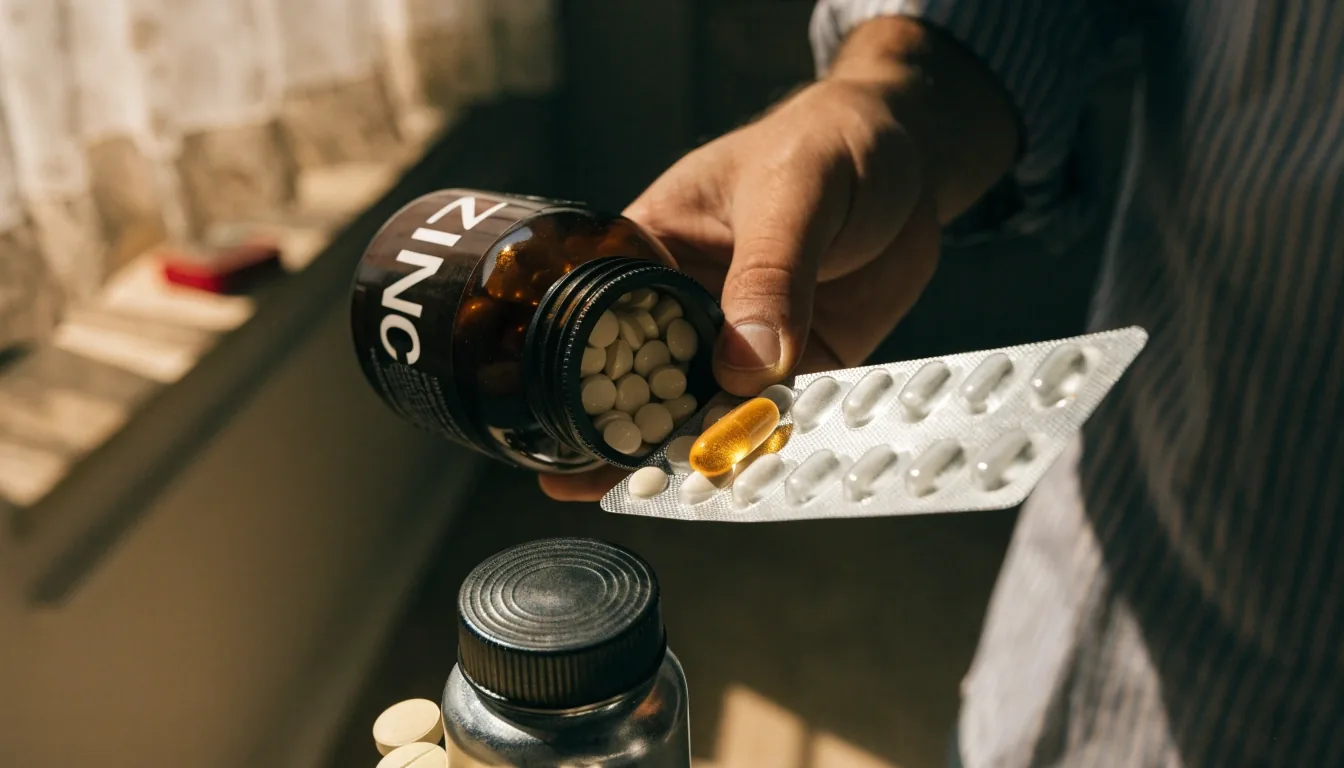
A once-daily men's multivitamin or capsule is easiest to keep up with when it sits next to something you already do. Breakfast is the common choice; a morning water bottle works too. The point is to remove the decision from your day. If you have to remember it, you will eventually forget it. Pick one anchor, put the bottle where you can see it, and let the habit ride on the routine that already exists. That single change does more than any elaborate schedule.
If you are still choosing what to take, the ingredient library breaks down what each vitamin and mineral is commonly included for, and the product comparisons line up the formats side by side. Neither page tells you what to buy — they give you the vocabulary to read a label without guessing.

One anchor, one visible bottle. If it lives in a cupboard, it does not exist.
Hydration without overthinking it
Hydration is the least glamorous part of any routine and the one most often skipped. You do not need a complicated tracking system. Keep a bottle within reach during your working hours and refill it at the same points each day. If you drink coffee, add a glass of water alongside it. The goal is steady intake rather than a large amount at once. It pairs naturally with a supplement routine because both are anchored to the same moments.
Two refill points are usually enough to remember: one after your first coffee, one after lunch. Anything more elaborate tends to be abandoned by the second week. If you are already carrying a bottle to work, that habit is doing more for your routine than most healthy lifestyle products you could add on top of it.
Movement that fits a real week
You do not need a training program to support a wellness routine. A short daily walk, a few bodyweight movements in the morning, or a consistent weekend activity all count. What matters is that it is repeatable and does not depend on equipment or a gym you rarely visit.
Energy and endurance supplements are often marketed alongside training, but the training is the part that does the work. Pick movement you will do on a bad week, not just a good one.
These are starting points, not targets. Adjust the length and frequency to what your week can actually carry.
Sleep as the base layer
Sleep is the foundation the rest of the routine sits on. A consistent bedtime matters more than a perfect one, and a wind-down period helps more than most people expect. Dim the room, put the phone down, and keep the last half hour predictable. If your sleep is irregular, adding supplements will not fix the gap. Treat sleep as the first thing to stabilize, then layer the rest on top. It is also the cheapest change available.
A simple weekly checklist
Keep the checklist short enough that you will actually use it. Five lines is enough. If a week goes badly, the checklist shows you which line broke rather than leaving you guessing. It also gives you something concrete to adjust next week instead of starting over.
Print it, keep it in a note on your phone, or write it on the back of an envelope. The format does not matter as much as reviewing it once a week on the same day.
Tick these as you go through the week. Nothing is saved or sent — it is a working list for your own review.
Adjusting when the routine breaks
Routines break. Travel, deadlines, and illness all interrupt them. The useful skill is restarting without drama. When a week falls apart, go back to the single anchor and rebuild from there, rather than trying to restore the whole checklist at once. Most people find the supplement habit returns quickly once the anchor is back. If a routine keeps breaking in the same place, that is a signal the anchor is wrong, not that you failed.
A common example: the morning formula keeps getting skipped because the mornings are rushed. Rather than forcing it, move the anchor to lunch, where the day is quieter. The habit is the same; the attachment point changed. That is the whole trick.
Restart at the anchor, not at the checklist. One habit back is enough for the week to count.
If a routine breaks three weeks running in the same spot, treat that spot as the problem. The fix is usually to move the anchor or shorten the habit, not to try harder at the same time of day.
When to stop and reassess
Give any routine a few weeks before judging it. If a product or habit is not fitting, the honest move is to change one variable at a time so you can tell what made the difference. If something feels off, pause and reassess rather than pushing through. Supplements are meant to support a routine, not to override what your body is telling you.
These products are not medicines. They are intended as dietary supplements alongside food, water, movement and rest. If you have a health condition, are taking medication, or are unsure whether a product suits you, talk to a qualified professional before starting anything. That advice holds whether the product is a single mineral or a full men's vitamin supplement.

Change one thing at a time and give it a few weeks. A pile of new products at once tells you nothing about which one mattered.
Questions we get about timing
Two questions come up more than any others when readers are building a routine around vitamins and minerals for men. If yours is not here, the editorial team answers routine questions by email during working hours.
What time of day should I take a daily supplement?
Anchor it to something you already do, such as breakfast or your morning water bottle. The exact time matters less than the consistency of the anchor. If the anchor shifts daily, pick a more stable one.
Do I need energy and endurance supplements to build a routine?
No. Movement, hydration, and sleep do most of the work. A daily formula can sit alongside those habits, but it does not replace them. Build the routine first, then decide what to add.
What if I miss a day?
Pick up at the next anchor rather than doubling up. One missed day is not the thing that breaks a routine — losing the anchor is. If you miss several days in the same spot, that is worth looking at before you change anything else.
How long before I can judge whether a routine is working?
Give it a few weeks of steady practice before you judge it. Change one variable at a time so you can tell what made the difference, and note how you feel in the review line of the checklist. If something feels off, pause and reassess rather than pushing through.
Where to go next
Keep the routine, then read the labels properly
A routine is only as useful as the product sitting inside it. The ingredient library explains what each vitamin and mineral is commonly included for, and the label guide walks through the terms you will meet on a supplement pack — serving size, amounts, and what a blend line usually means.
You can also reach the team directly at [email protected] or on +62 21 501 5881, Monday to Friday, 9:00 AM – 6:00 PM (WIB).